Solar energy has become a financially compelling option for commercial properties across a growing number of U.S. markets. The combination of federal tax incentives, declining panel costs, and rising retail electricity rates has shifted solar from a sustainability statement to a genuine cost reduction strategy. But the solar landscape for commercial properties is more nuanced than residential installations. Property managers must navigate structural considerations, ownership versus lease models, net metering policies that vary dramatically by state, and the emerging community solar alternative for buildings where on-site installation is impractical.
This article provides a practical framework for evaluating solar options for commercial portfolios. We cover the economics of rooftop and carport systems, the mechanics of community solar subscriptions, and the state-by-state net metering landscape that determines whether solar pencils out for your specific properties.
The Commercial Solar Landscape in 2026
The economics of commercial solar have improved substantially over the past three years. The Inflation Reduction Act extended and expanded the Investment Tax Credit (ITC) to 30 percent through 2032, with bonus adders available for projects that meet domestic content requirements, are located in energy communities, or serve low-income areas. These bonus adders can push the effective tax credit to 40 or even 50 percent of project costs, fundamentally changing the financial calculus for commercial installations.
At the same time, commercial electricity rates have increased by an average of 15 to 25 percent across major markets since 2023. The combination of grid infrastructure investments, fuel cost pass-throughs, and growing demand from data centers and electrification has pushed retail rates higher in virtually every region. This widening spread between solar costs and grid costs is the primary driver of improving solar economics.
Installed costs for commercial rooftop solar now average between $1.50 and $2.50 per watt, depending on system size, roof conditions, and local labor markets. For a 200 kW system on a typical office building, that translates to a total installed cost of $300,000 to $500,000 before incentives. After the 30 percent ITC, the net cost drops to $210,000 to $350,000. With additional state and local incentives available in many markets, the effective cost can be lower still.
Rooftop Solar: Opportunities and Constraints
Rooftop solar is the most common configuration for commercial buildings, but it is not universally feasible. Several factors determine whether a building is a good candidate for rooftop installation.
Structural and Physical Considerations
The roof must have adequate structural capacity to support the weight of the solar array, which typically adds 3 to 5 pounds per square foot for ballasted systems. Buildings constructed before modern seismic and load codes may require structural reinforcement, which can add $50,000 or more to project costs. Roof condition is equally important. Installing solar on a roof that will need replacement within the next 10 years creates a costly re-roofing scenario where the entire array must be removed and reinstalled.
Shading, roof orientation, and available area all affect system performance. South-facing roofs with minimal shading from adjacent buildings or mechanical equipment produce the highest yields. East-west oriented roofs can still be productive but generate approximately 15 to 20 percent less energy annually. Rooftop mechanical equipment, HVAC units, elevator penthouses, and setback requirements from roof edges all reduce the usable area. A 50,000 square foot roof may only have 25,000 square feet of usable solar area after accounting for these constraints.
Ownership vs. Power Purchase Agreements
Commercial solar can be structured as a direct purchase, a lease, or a power purchase agreement (PPA). Direct ownership maximizes long-term financial returns because the building owner captures the tax credit, depreciation benefits, and all energy savings. However, it requires upfront capital and assumes the owner has sufficient tax liability to utilize the credits.
PPAs transfer ownership of the solar system to a third-party developer who sells the electricity to the building at a fixed rate, typically 10 to 30 percent below the current utility rate. The PPA model eliminates upfront costs and transfers performance risk to the developer, making it attractive for properties with limited capital budgets or for non-profit organizations that cannot use tax credits. The trade-off is lower total savings over the 20 to 25 year life of the system.
Carport Solar: Dual-Purpose Infrastructure
Solar carports are elevated structures that support solar panels over parking areas, providing both renewable energy generation and covered parking for tenants and visitors. Carport installations are particularly relevant for suburban office parks, retail centers, and industrial properties with large parking areas and limited rooftop space.
The installed cost of carport solar is higher than rooftop solar, typically $3.00 to $4.50 per watt, due to the structural steel required for the canopy. However, carports offer several advantages that can offset the higher cost. They do not require roof modifications, they provide a tenant amenity in the form of covered parking, and they can be sized to match the property's full load rather than being constrained by roof area. Carport installations also pair naturally with EV charging infrastructure, creating additional revenue opportunities.
For properties with sufficient parking area, carport solar can generate significantly more energy than a rooftop system alone. A 500-space parking lot can support a solar array of 1 MW or more, generating enough electricity to offset a substantial portion of the property's total consumption.
Community Solar: When On-Site Is Not Feasible
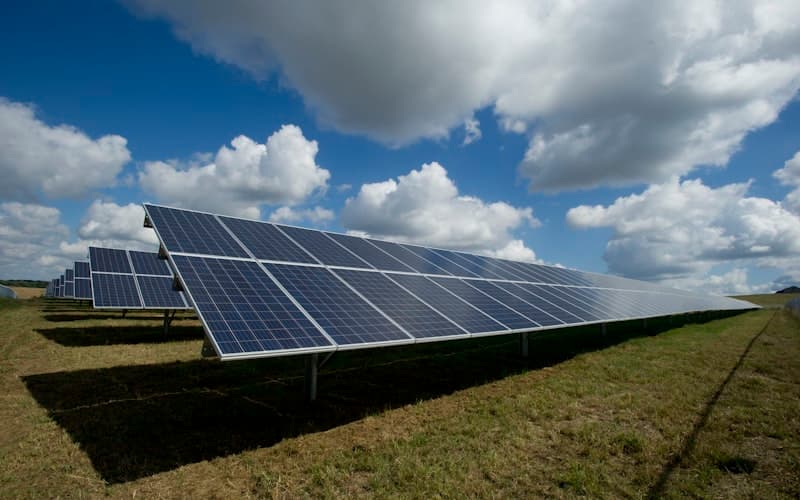
Community solar programs allow commercial customers to subscribe to a share of a solar farm located off-site and receive credits on their utility bill for their portion of the energy produced. Community solar is ideal for buildings where on-site installation is not feasible due to structural limitations, roof condition, shading, historic preservation requirements, or lease restrictions.
How Community Solar Works
In a typical community solar arrangement, the subscriber enters into a contract with a solar farm developer for a specified allocation of the farm's output. The solar farm feeds electricity into the local grid, and the subscriber receives bill credits from their utility based on their share of the production. The credit rate varies by state and utility but is typically set at or near the retail rate, meaning each kilowatt-hour of community solar production offsets a kilowatt-hour of grid consumption on the subscriber's bill.
Community solar subscriptions typically offer savings of 5 to 15 percent on electricity costs with no upfront investment and no physical changes to the building. Contracts typically run 15 to 25 years, though some programs offer shorter terms. The key advantage is simplicity: there is no equipment to install, maintain, or insure, and the savings begin immediately.
Availability by Market
Community solar availability varies significantly by state. States with robust community solar programs include New York, Massachusetts, Minnesota, Illinois, New Jersey, Maryland, and Colorado. California launched an expanded community solar program in 2024 that is now generating significant subscriber interest. States without enabling legislation or with restrictive program caps may have limited or no community solar options.
For multi-state portfolios, community solar can be a particularly attractive strategy because it can be deployed across any property in an eligible market without the site-specific engineering and permitting required for on-site installations.
Net Metering: The Policy That Makes or Breaks Solar Economics
Net metering policies determine the value of solar energy exported to the grid when on-site production exceeds building consumption. Under full retail net metering, each kilowatt-hour exported to the grid offsets a kilowatt-hour of consumption on the next bill at the full retail rate. This is the most favorable policy for solar economics.
However, net metering policies are under pressure in many states. California's NEM 3.0 policy, implemented in 2023, reduced export compensation by approximately 75 percent for new solar customers, dramatically extending payback periods. Other states are considering or have implemented similar reductions. The trend is toward compensation based on avoided cost or wholesale rates rather than retail rates, which typically values exported energy at one-third to one-half of the retail rate.
For commercial properties, the impact of net metering policy depends on how well solar production aligns with building load. Office buildings with high daytime occupancy and consumption often self-consume 60 to 80 percent of solar production, minimizing their exposure to unfavorable export rates. Industrial properties with consistent baseload consumption may self-consume an even higher percentage. Properties with low daytime loads or weekend-heavy usage patterns are more exposed to net metering policy risk.
Evaluating Solar for Your Portfolio
The decision framework for commercial solar starts with understanding your utility cost baseline. Properties paying more than $0.12 per kilowatt-hour are generally strong candidates for solar, with payback periods of five to eight years for owned systems. Properties in markets with rates above $0.18 per kWh often achieve payback in three to five years.
- Assess feasibility: Evaluate each property for rooftop capacity, structural adequacy, roof condition and remaining life, shading, and available area.
- Understand local policy:Research net metering rules, interconnection requirements, permitting timelines, and available incentives for each property's jurisdiction.
- Model the economics:Obtain proposals from at least three qualified commercial solar developers. Compare direct ownership, PPA, and lease structures based on your organization's tax position and capital availability.
- Consider community solar: For properties where on-site solar is not feasible, evaluate community solar programs in the local market as a no-capital alternative.
- Plan for integration: Ensure your utility data management system can track solar production alongside grid consumption to measure actual savings and maintain accurate benchmarking data.
Solar is no longer a question of whether it makes financial sense for commercial properties. In most markets, it clearly does. The question is which configuration, on-site rooftop, carport, or community solar, best fits each property in your portfolio.